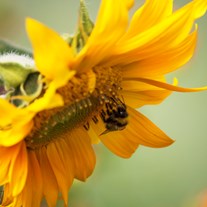
Bees are some of the world’s most marvellous creatures. They hum and dip across your garden or chart a high meander through an orchard of apple trees, darting from flower to flower, poking their heads into petals to find nectar and pollen. In return, the bees help the flowers by spreading their pollen. This is called pollination. Many plants would not be able to fertilise without bees and other pollinators. This relationship is symbiotic as both bee and flower help each other to reproduce and succeed.
We are dependent on bees to fertilise many of our crops
We need bees to fertilise many of our crops. Butterflies, moths and other insects pollinate too, but bees are estimated to provide billions of dollars' worth of pollination services to farmers worldwide. Many of the world’s food crops depend on insect and animal pollination to some degree. Pollinators are essential for growing many different fruits, nuts and berries. There are around 70 crops in the UK that depend or benefit from bee pollination.
Pollination by honey bees, wild bees and bumblebees is incredibly valuable for farmers. It is estimated that it would cost UK farmers £1.8 billion a year to pollinate their crops manually if wild bees disappeared. Clearly, it would be an incredibly laborious and enormously expensive task for farmers and growers to manually pollinate their trees and crops. Sadly this is already the case in some parts of China where natural pollinators have disappeared.
There is no plan bee
The bigger question is whether it would even be possible to achieve the same productivity as the hardworking bees, if we had to pollinate manually in the UK. Research has found that honey bees used to do 70 percent of the pollination in the UK. Now, the honey bees are only capable of supplying 34 percent of our pollination needs. This gap is now being filled by wild pollinators, such as bumblebees and hoverflies.
It is scary to imagine a food system without bees. But, this might happen if we are not careful to avoid harmful pesticides and find methods for reducing the infestations of the varroa mite.
Many bee species are in decline, but there are some bumblebee and solitary bee species that haven’t declined and are actually doing well. These are mainly the bee species that are not dependent on specific flowers, but can collect pollen from a range of sources.
I want to stop pesticides killing our bees
Other benefits
The benefit of bees is usually measured on the basis of the products that come from them directly. Honey is of course the most popular product. Bees collect nectar from flowering plants or honeydew from coniferous trees and store the juices in their honey stomach. The harvest is stored in honeycomb in the hive and processed and dried by the hive bees. Only when the water content is under 18 per cent can the honey be harvested, up to four times a year.
Honey is harvested by the beekeeper using a honey extractor. First, the wax covering is removed from honeycombs in their frames and they are then put into a honey extractor. The centrifugal force in the honey extractor draws the honey out of the individual cells without destroying them. The beekeeper then returns the honeycombs to the beehive. The honey flowing out of the extractor is collected in a container and filtered through a sieve a few times to ensure that it no longer contains any wax or propolis residue (bee glue). Then the honey is put into honey jars and left for a few days so that air bubbles and the smallest particles of wax can rise to the surface.
More healing properties from the bee colony
Another bee product is wax, which is primarily used as a natural product by the cosmetic and pharmaceutical industries. It is a product excreted from the glands of the honeybee. The bees use the wax to construct the honeycombs. Old, brown honeycomb is removed by the beekeeper and melted down, and impurities are removed. The wax, which is now light and pure again, is cast into new wax centre walls and returned to the colonies or recycled in other ways. Beeswax is a valuable raw material that can be used to make beeswax candles, among other things. The wax from an entire beehive is needed to make one candle. Beeswax candles emit a soft light and fill the room with a pleasant aroma.
Pollen
Pollen is also a popular product. All plants produce pollen, which the bee picks up when it visits flowers, enriches with nectar and transports to the beehive. Within a year a single bee colony collects between 30 and 60 kilograms of pollen. The beekeepers attach a pollen trap at the entrance to the beehive to collect it. Pollen is often used as a nutritional supplement. Pollen is rich in vitamins, minerals and proteins. It strengthens the immune system and improves mental capacity.
Bee glue
Bee glue, also known as propolis, is another important bee product. Bees collect resin from different trees, bring it to the beehive for sealing purposes and thus protect themselves from bacteria and fungi. A bee colony is capable of collecting 50 to 500 grams of resinous mass per year. Propolis is used in many medicinal products. It is a natural antibiotic as it has an anti-inflammatory effect and strengthens the immune system. The active ingredient is available for people in capsule form, as a medicinal ointment, cream or herbal drink.
Royal jelly
However, probably the most valuable bee product is royal jelly. It can only be produced by young worker bees, which make it out of honey, pollen and their own glandular secretions. Only the queen bee gets to eat the royal jelly, and it gives her a life expectancy 50 times longer than her colony. For this reason, the queen bee is a symbol of vitality as well as performance and vigour. Royal jelly is used in the cosmetics industry as well as the medical industry. It can be used as a natural remedy for viral infections and has a revitalising effect.
Right now, 35 bee species face extinction, and 71 percent of our butterflies are in decline. That's one of the reasons we campaign for farming that works in harmony in nature, not against it.