
Fast trees for shade and shelter
Fast trees for shade and shelter – how to guide
Published 01 Oct 2026
Building climate resilience and productivity
Planting trees within grazing systems provides shade, shelter and browse for livestock. If your animals don’t have enough shade or shelter, they will suffer and so will your bottom line. Weather extremes are getting more common, with blazing sun, heavy rain, and violent winds.
This guide outlines the quickest growing species that can deliver shade, shelter and browse, and covers planting, establishment and ongoing management techniques, that will help your trees race away, delivering those much-needed benefits. Quick growth also reduces the time land is taken out of production to establish trees.
Existing trees
Are you managing your existing trees and hedges for maximum benefit? Before planting more, evaluate your existing assets. For instance, a well-designed shelterbelt can provide shelter for up to twenty times its height, increasing the temperature for stock and crop by 4–5 degrees. A hedge 5m tall and “tortoise shaped” could provide 100m of shelter.


Which tree species?
Diverse plantings do better than trees on their own or single species stands. Roundel designs, Miyawaki type very dense plantings, and mixed or alternate multiple rows are likely to give you the best start.
Go for “pioneer” species, often Nitrogen fixing, thorny, or adapted to quickly colonising bare land providing protection for slower growing species to come along behind. You may also want to include tasty browse species. The quickest growing are hybrid willow and poplar which can grow 2m/yr.
Include alder, birch, sea buckthorn, hawthorn, willow, poplar, rowan, dogwood, aspen, hazel.
Planting
Ground prep – Clear perennial weeds and competitive grasses before planting. In heavily cropped arable land add composted or ramial woodchip to build fungal population, and inoculating with diverse fungi mixes (proprietary or DIY).
Planting – Wide range of methods, manual and mechanical, depending on species, soil and scale. Key is to plant early (ideally by the end of February), and ensure the roots are properly covered and firmed in well.
Irrigation – Early planting and a good mulch reduce the need for irrigation even in a dry year. However watering new plantings in the first (and even second) year can significantly increase survival rates and early growth.
Weed control
Weed control – Mulch with 25cm deep, 1m diameter of woodchip for the ultimate weed control, moisture retention and soil health benefits. Other organic mulches like straw or compost work well but will not last and often require a second treatment.
In a dry year spraying weeds around the tree can do more harm than benefit, leaving the soil surface exposed to the sun. Plastic mulches give good weed control and moisture retention but don’t help soil health and contribute to plastic micro pollution. Mulch mats work well but can encourage voles.
Fencing, guards and ongoing management
Fencing is a “cost vs risk” decision. Spending on good protection will result in quicker establishment and early growth. Consider the threat from both wild and farmed animals.
Nurture for 2–3 years after establishment to improve survival and growth. Key checks include:
Guards – have they broken/come off, have ants or field mice colonised them?
Staking – use a strong stake and check regularly especially after high winds.
Re-mulching – even a thick woodchip mulch will break down, if the tree is struggling apply another mulch in year two or three.
Costs, savings and improvements
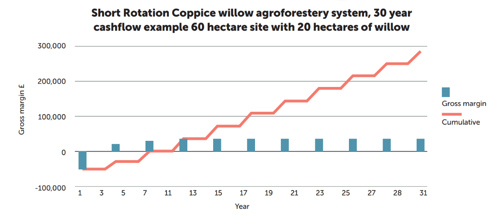
Every species and design is different, so it is hard to give definitive financial guidance. If trees grow well initially you will see some initial returns through productivity and resilience within three years on good land from the quickest species.
Hybrid willow and poplar are the quickest to offer an income from the tree itself with a potential harvest in year three, though this will temporarily reduce the other benefits the trees are providing. Harvesting one third of your trees each year can give a good balance between system benefits and income
Useful information
Farm Woodland Forum: agroforestry.ac.uk
Woodland Trust: woodlandtrust.org.uk
Tree Council: treecouncil.org.uk
Organic Research Centre: organicresearchcentre.com
Willow Solutions: willowsolutions.info
Eco Crops: ecocrops.co.uk