Soil testing: who are you doing it for?
Soil scientist and technical director of Farm Carbon Toolkit Becky Willson gives us guidance for testing soil organic matter and soil organic carbon, and why knowing who you’re testing for is key.
The best time to start testing your soil was 20 years ago. The next best time is today.
Main analysis methods
Testing Soil Organic Matter
The key process for testing soil organic matter (SOM%) is Loss On Ignition (LOI). It measures the weight of a dried soil before and after burning away its organic matter (at between 450 and 550 degrees C) which is turned into a percentage.
When to take samples
It is good to test the soils either in the spring or the autumn, but it is also important to be consistent in your approach to look at change over time.
Testing Soil Organic Carbon
The key process for testing soil organic carbon is Dry Combustion (also known as the Dumas method), which burns samples at up to 1000 degrees C. The carbon released is measured as a gas and turned into a percentage. If you are having your soils analysed using Dumas then ensure that the lab is providing a value for organic carbon and inorganic carbon. The amount of soil that is tested is very small so ensure that the samples which are sent in are a good representation of your field.
When to take samples
It is good to test the soils either in the spring or the autumn, but it is also important to be consistent in your approach to look at change over time.
Who needs to know what?
Defra grants and funding
Defra are interested in soil health, soil structure and worms, so the key metric for Sustainable Farming Incentive standards etc is SOM%.
Carbon market
The open and emerging carbon markets are looking for information about soil organic carbon percentage (SOC%) and carbon stock (tons of carbon across each hectare). To calculate carbon stock you need to know the bulk density of soil (mass) and the depth of the sample.
Your own farm management
If you’re interested in finding out more about your farm’s soil health and variations across the farm, you can decide your own metrics. You might want to do this to understand better what effect good soil health has on soil performance, as well as your margins and profitability.
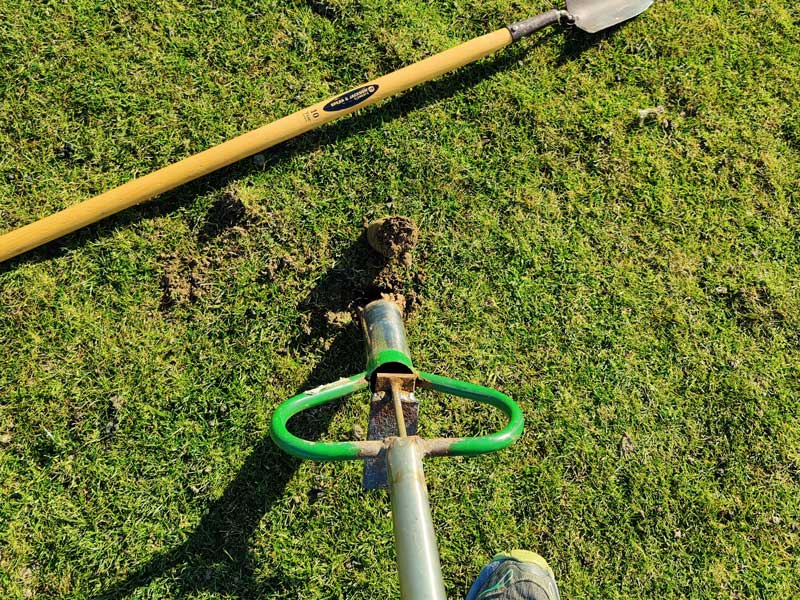
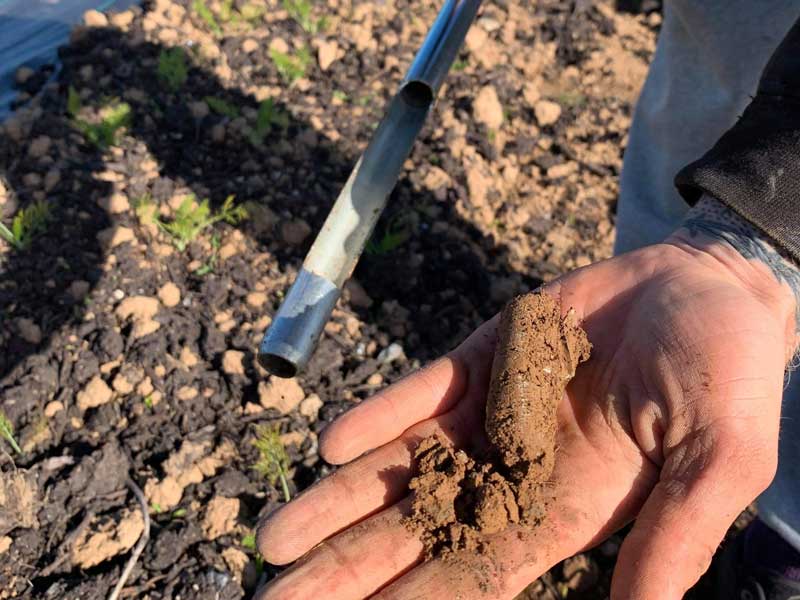
Your spade is your best friend! Go back to basics, dig a hole and look at your soil to analyse:
Water infiltration
Nutrients
Soil structure
Root penetration
Worm numbers
Other wildlife and biodiversity numbers
When to take samples
Soil conditions will vary depending on the time of year you take your samples, ie worm count, nutrients, weather conditions etc.
Be consistent
Whatever you decide to do, consistency is key.
Take samples from several representative locations across the farm, using a transect, grid or ‘W’ route of a field, and using GPS coordinates or What3Words to accurately test in the same place each time.
Capture variations in soil type, cropping systems, soil management, texture and clay content.
Sampling depths: 0-10cm; 10-30cm; 30-50cm. FAO (Food and Agriculture Organization) recommend testing to a depth of 30cm.
Take samples at the same time of year (and not soon after cultivation, manure spreading etc).
Record field conditions (hot, dry, wet, soil temperature etc).
Use the same soil testing company.
Soil in good health should be 25% water, 25% air and 50% organic matter. 60% of soil organic matter is soil organic carbon.