Business support
UK-EU SPS agreement
The Sanitary and Phytosanitary (SPS) agreement is set to reduce trade barriers for organic food and farming businesses. Your business may need to make significant changes to prepare for the benefits while staying compliant.
On this page
On this page:
On this page
On this page
What is the SPS Agreement?
Due to take effect in 2027, the new Sanitary and Phytosanitary (SPS) agreement brings opportunities for smoother trade between the UK and the EU.
Many of the changes are designed to reduce costs, paperwork and delays at borders – opening trade in a way we haven’t seen since Brexit. However, businesses may need to change processes significantly to stay compliant. All food and farming businesses will be affected.
This page details our latest guidance on what the SPS agreement means for organic businesses, and how to prepare. We will update our guidance as new information becomes available. You can also view full details of the SPS alignment on the government website.
Watch the webinar
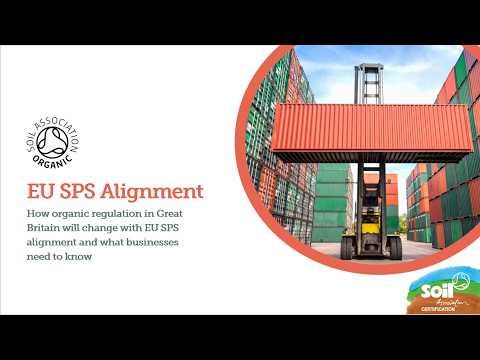
We are hosting a series of free webinars to share new information, answer questions and gather feedback from businesses navigating the SPS alignment changes. Watch our webinar from 22 September below. Sign up to our Trade News email newsletter to hear about the next webinar.
Has the SPS alignment been finalised?
No - the UK and EU are still discussing some of the rules. This means the information on this page may change and may not cover everything. We will update it as new information becomes available.
Please check for Certification Updates regularly, and check the date of last update on each page and guidance document you view.
We will also send updates by email – please sign up to our Organic Trade News emails if you haven’t already.
How does the SPS affect UK organic businesses?
The agreement includes organics within the scope. While some details are still being negotiated, Defra has confirmed the UK will dynamically align with the EU organic regulation 2018/848. This effectively means the UK will implement this regulation.
Most elements of organic regulation will remain unchanged. Some areas of the EU regulation are more detailed or use slightly different wording and won’t necessarily mean a change to how organic products are produced. Some make the emphasis or the intention of a requirement clearer.
The changes do not cover requirements associated with Soil Association higher standards.
When does the SPS agreement come into force?
The changes are expected to be in force by as early as summer 2027. We recommend you start planning for them as soon as possible.
Does GB still follow GB regulations?
Yes – until the SPS agreement comes into force, GB will continue to follow the GB organic regulation. You can make changes to prepare, if they don’t conflict with the current regulation.
For example, you would not be able to use a food additive that’s not permitted under the current GB regulation, but you could switch to a natural favouring that is compliant with the EU regulation.
Exporters to the EU, NI or EEA must continue to follow all existing requirements of the Trade and Cooperation Agreement (TCA).
Transition periods
We are waiting to hear from Defra on whether transition periods will be permitted. If they are, this could extend how long organic businesses have to meet certain EU rules, such as rules for poultry, existing labelling stock, new requirements for natural flavourings, and placing pre-SPS products on the market.
We recommend that organic businesses:
consider other regulatory changes: how rules on organic may interact with these
understand all actions they need to take, including:
product specifications
labelling
operational changes
treat all the information on this page and related Soil Association Certification pages as correct at the time of publication, and subject to change as regulations change
Changes for all organic businesses
Imports and exports
Although there could be some exceptions, for the majority of goods covered under organic regulation, Certificates of Inspection (COIs) will no longer be needed when exporting from Great Britain (GB) to the EU, EEA or Northern Ireland (NI). They will also not be required for goods imported into GB from the EU or EEA.
It also appears that products imported into GB will no longer need to be processed in GB before being re-exported to the EU, EEA or NI. However, this has not yet been officially confirmed by Defra.
UK businesses are not expected to need certification simply because they import goods from the EU, EEA or NI, or because they export goods to the EU or EEA, although the requirements for certification for wholesaling and storage will remain.
For goods imported into GB from countries outside the EU, the UK will switch to using the EU's TRACES system to manage Certificates of Inspection. The UK will also follow the EU's lists of approved third countries and certification bodies. Further guidance on how to use the TRACES system will be provided.
In short: Trade between GB and the EU/EEA is expected to become simpler, with fewer certification and inspection requirements. Organic businesses importing from or exporting to the EU/EEA are unlikely to need certification just for those activities, while imports from non-EU countries will be managed through the TRACES system.
Dual certification
Rules on dual certification of operators will change. An operator cannot have certification with more than one certification body (CB) for the same category of products in the same country. For example:
an egg producer who also packs eggs could not have certification with two or more CBs, because both the production and the packing would remain within the same category (unprocessed)
an egg producer who also processes eggs into mayonnaise could have certification with different CBs as the egg production would be an ‘unprocessed product’ and the mayonnaise a ‘processed product’
For more detail on changes to certification and inspection of business operations, please refer to our additional 848 operational certification and inspection guidance.
Certificates of registration
Operator certificates will be issued and accessible through the EU’s TRACES NT system.
For more detail on changes to certification and inspection of business operations, please refer to our additional 848 operational certification and inspection guidance.
Inspections
There will be a change in the inspection frequency for low-risk wholesaler and storage operations who are currently on a 3-year inspection cycle.
848 requires all operators to have an annual inspection (physical on-the-spot inspection) at least once a year, with the exception of those assessed as low-risk, being subject to inspections up to 24 months apart.
For more detail on changes to certification and inspection of business operations, please refer to our additional 848 operational certification and inspection guidance.
Changes for farmers and growers
Inputs
Several inputs will be allowed that are not currently permitted in the GB regulation. These can’t be used before SPS is implemented.
Some inputs will have added restrictions on use, for example ethylene. However, we are working with Defra to determine how rules are currently being implemented in the EU and if any products will be affected by the changes.
There are new definitions and requirements around plant reproduction material including new rules around the use of heterogeneous material and specific requirements for organic plant reproductive materials.
For full details on changes to inputs, please refer to our 848 input comparison guidance spreadsheet, which we will send to Soil Association Certification clients by email.
Conversion to organic
While there are no changes to the land conversion requirements, there are more detailed requirements associated with requests for reduced conversion periods.
Groups of operators
There are new rules for groups of operators.
These are more relevant to existing grower groups in third countries who are already required to demonstrate compliance with EU regulations (for example, those producing crops such as cocoa, coffee and bananas).
As such, these restrictions are unlikely to be directly relevant for groups of producers in GB.
As the UK will adopt the EU lists of approved third countries and certification bodies, all certification detailed as acceptable in these lists will be in compliance with EU requirements on grower groups.
Crop production – general requirements
Some requirements will become more detailed and prescriptive, but will not require any change of practice. These are in areas such as:
objectives and principles
crop rotation
plant reproductive material
action in the case of a residue detection
For more details on requirements applicable to your farm, please refer to current production standards for Northern Ireland.
Crop production – movement of crops
Alongside organic requirements, other phytosanitary controls will be further relaxed. For example, movement of seed between EU and GB should become easier.
Poultry production
The EU has different requirements in a number of areas, some of which will require significant changes. The EU and Defra have yet to confirm transitional measures to help the UK meet EU requirements over time.
For more details on what we know at this time, please refer to the guidance provided for more information on:
origin of stock
housing (basic overview is provided below)
stocking density and ranging
pullet rearing
Please see more detailed guidance on new requirements for poultry.
All livestock production
The EU regulation includes detailed rules for rabbits and deer which were not included in GB regulation.
The EU requires an organic livestock database (similar to the existing GB seed database) to be used, to ensure organic stock is listed when available.
Feed – origin
Requirements for origin of feed will change. At least 30% of feed for pigs and poultry and 70% of feed for herbivores shall come from the farm itself. This represents an increase from 20% for pigs and poultry and 60% for herbivores.
If this is not possible or such feed is not available, feed must be produced in cooperation with other organic or in-conversion production units and feed operators using feed and feed material from the same region.
The definition of "region" will be critical in determining the impact of this change, as currently, "region" is defined as within the EU.
Feed – general
There are several changes to origin and composition of feed as we move to EU regulation. We recommend reading the general guidance and specific guidance on permitted inputs.
For more detail on requirements related to feed, please refer to our additional guidance.
Feed – in-conversion
The amount of in-conversion feed that can be bought in will reduce from to 30% to 25%.
Feed – materials
Feed materials now include a much longer list including:
yeast and yeast extracts that do not need to be considered within the non-organic protein allowance
algal and fish oils
calcium stearate
Young pigs and poultry can continue to be fed up to 5% non-organic protein feed ingredients if suitable organic alternatives are not available.
For full details on changes to inputs, please refer to our 848 input comparison guidance spreadsheet, which we will send to Soil Association Certification clients by email.
Housing – pig
There are new requirements for:
space for pigs to lay down flat out (all at the same time)
extra straw to be provided to nesting sows
There is more emphasis in the EU regulation on the outside areas being made attractive to pigs with preference to fields with trees, and a new restriction limiting the amount of slats being used in outside areas for pigs to less than 50%.
Housing – poultry
EU regulations have different requirements on:
subdivision of poultry
perching for table birds
table chickens, turkeys, and guinea fowl perches or raised sitting levels
verandas, pop-holes and ranging areas
multi-tiered housing
Please see more detailed guidance on new requirements for poultry.
Changes for food and drink businesses
There are several changes to composition of organic food and drink as we move to EU regulation. We recommend reading the general guidance and specific guidance on permitted additives, processing aids, natural flavours and labelling.
Ingredients – scope
The scope of the EU regulation is more detailed, making it clearer that certain agricultural products are within scope. These include natural gums and resins, beeswax, and wool.
For more detail on 848 scope please refer to our additional guidance.
Ingredients – essential oils
No longer restricted to food use only, under the EU regulation essential oils can be certified organic regardless of their final use (for example, in cosmetic products).
For more detail on the 848 scope, please refer to our additional guidance.
Ingredients – salt
Under the EU regulation, salt production can be certified organic. There are currently no EU wide rules on production; these exist at member state level. There are currently no plans for UK production rules. Salt certified organic in an EU member state could be imported and labelled as organic in the UK.
Businesses may continue to use non-organic salt in their products. There is no requirement to use organic salt.
For more detail on 848 scope, please refer to our additional guidance.
Ingredients – non-organic, of agricultural origin
Most of the ingredients previously listed in the regulation, for example dried raspberries, cola nuts, pea protein, fructose and starches, will no longer be permitted for use in non-organic form. The following are permitted, under specific conditions:
2 types of algae
bark of the Pau D'Arco tree
aquatic organisms (not originating from aquaculture)
gelatine
milk mineral powder / liquid
casings
It will still be possible to obtain derogations from Defra, but under stricter conditions.
For more detail on requirements related to non-organic ingredients, please refer to our additional guidance.
Permitted additives and processing aids – general
All existing additives and processing aids permitted under GB retained regulations can continue to be used. However, some have additional or different conditions attached, so it is important to check if these changes will impact your products.
For example, existing permitted additives such as E335, E336, E901, E903 and E968 must be included in organic percentage calculation and both E335 and E336 must be organic from January 2027.
EU regulations also contain newly permitted additives (e.g. E267 and E337 – with restrictions) and processing aids (gelatine, pea protein and potato protein).
Ethylene is permitted for use on bananas and potatoes and for use on citrus for the prevention of fruit fly damage. This has implications for current use for ripening of kiwi fruit and avocados and sprout suppressant for onions.
There are new rules on the composition of pet foods.
For more detail on 848 requirements for additives and processing aids, please refer to our additional guidance.
Permitted additives and processing aids – yeast and production of wine from grapes
Nutrients from yeast extract or autolysate will need to be used as fermentation activators in organic yeast production, but must not exceed 5% of the weight of the dry substrate.
Perlite, cellulose and diatomaceous earth are no longer permitted in production of wine from grapes.
EU regulations are less prescriptive on use of calcium sulphate in wine production. It permits fresh lees – provided they are from organic production.
Natural flavourings
The new EU regulation makes several changes to the rules for natural flavourings. As a result, all flavourings will need to be reviewed to make sure they still comply with the requirements. In some cases, recipes may need to be changed and product labels updated.
Non-organic natural flavourings will now count as agricultural ingredients when calculating organic content. This means that any non-organic flavourings used must make up no more than 5% of the product.
These flavourings must also be either natural flavouring substances or natural flavouring preparations and must meet the labelling requirements set out in Article 16(2), (3) and (4) of Regulation 1334/2008. In practice, this means that at least 95% of the flavouring must come from the named source. For example, if a flavouring is labelled as a natural lemon flavour, at least 95% of the flavouring must come from lemons.
The regulation also introduces new requirements for how organic flavourings are produced.
For more information on organic flavourings, natural flavourings, and the rules for using the term "natural" on labels, please refer to our additional guidance.
Pet foods
At least 95% of the product's agricultural ingredients, measured by weight, must be organic.
Any non-organic ingredients used in feed, including ingredients from plants, algae, animals, yeast, minerals, as well as feed additives and processing aids, must be listed as approved for use in Regulation EC 2021/1165.
Feed ingredients must not be processed using chemically synthesised solvents.
For more information about the requirements for organic pet food under Regulation 2018/848, please see our additional guidance.
Product labelling
Use of the EU leaf logo and statement of agricultural origin will become mandatory for pre-packed food products. The statement of agricultural origin must state whether the ingredients are from the EU, outside the EU, or a specific country or region.
For food and drink products, changes to the rules on flavourings may also affect product labelling. An increased number of additives are included in the product percentage calculations; this may mean some companies will have to amend specifications and labels to comply.
New requirements also apply to certain other product categories, including products from hunting and fishing, products that are in the process of converting to organic status, and pet food.
It is expected that businesses will be able to use either a UK or EU food business operator (FBO) address on product labels.
Processing techniques
Ion exchange and resin absorption will only be permitted for preparation of infant formula, processed cereal-based food and baby food for infants and young children, where doing so is essential to ensure that these products meet other mandatory regulatory requirements.
SPS guidance and resources
Download our PDF guides for more thorough guidance on the SPS changes that affect your business.